|
What’s Your Diagnosis?
Two 1 1 year-old intact male guinea
pigs “Ben and “Bill” are presented with flaky skin. The owner
has not observed the animals to be itchy but one bites you
when you touch the flaky area. There is no reported change
in faeces, urine, appetite, or thirst. Upon clinical examination,
both guinea pigs appeared BAR, and HR was N. Eyes look clear
and bright, and the ears appear normal. However, upon closer
inspection, a large number of yellow spots are seen adhering
to “Bill’s” inner thighs (see picture). When you run your
fingers through his coat over the spine, several tiny insects
appear then dart out of sight.
- What condition does this suggest
and what can you do to confirm it?
- Can the children who own “Ben” and
“Bill” be affected?
- How do treat the animals?
- What is the prognosis?
|

Sympathetic
itch caused Affected area of guinea pig
|
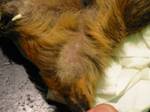
Guinea pig to bite
your arm. medial left leg surface.
|
Answer:
The yellow attachments
on “Bill’s” thighs are nits—the eggs of lice. To confirm the
diagnosis, gently press a piece of clear adhesive tape to
the nits and hair, peel it off, and place on a microscope
slide. You see eggs are glued to the hair, so they are obviously
not dirt specks, and the adult lice are clearly identifiable
at the 10x, and 40x level (see photo). These are chewing lice,
as evidenced by their wide head, and you are therefore able
to diagnose pediculosis. It bit you because of a sympathetic
puritic reaction when manipulating its itchy skin. Although
louse infestation is predominantly a winter condition, it
can occur at other times of the year. As lice are species-specific,
there is no need to worry about the children acquiring head
lice from their beloved pets. To treat “Ben” and “Bill,” administer
0.05ml DectomaxTM (doramectin) per os (see picture).
Repeat in 2 weeks with Frontline Spray in a warm, well-ventilated
area, being sure to prevent chill, as this product has isopropyl
alcohol which evaporates quickly. The cage should be thoroughly
cleaned. Be sure to advise the owner that these products are
licensed for use in other animals, but not guinea pigs, and
that this is an off-label use. Another choice for better accuracy
of dosing (although still off label) is StrongholdTM
(selamectin) 15 mg. for small cats.
The prognosis is
excellent.
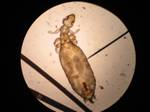 10x / 0.25 DIN
 |
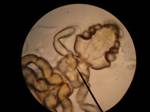 40x / 0.65 DIN
 |
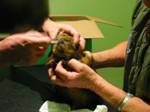 Administering medication
 |
|